 ®
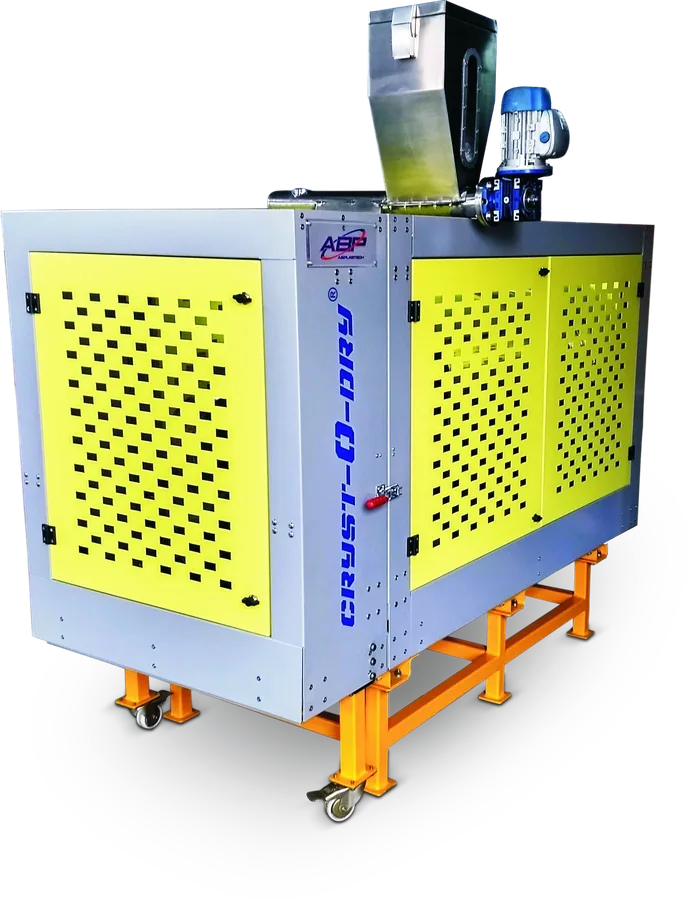
® Infrared rotary
crystalliser and dryer
India's first indigenously developed infrared rotary crystalliser and dryer. Indian Patent 297057. Proven. Installed and running.
Why PET must be crystallised and dried
PET is a highly hygroscopic resin — it absorbs moisture from the atmosphere during transportation and storage. When moisture-laden PET is processed at melt temperatures of 260°C and above, the water hydrolyses the polymer chains, causing loss of intrinsic viscosity, an increase in carboxyl groups, colour change, and irreversible deterioration of the final product.
Post-process and recycled PET present an additional challenge. Unlike virgin PET, which is semi-crystalline, post-consumer and scrap PET is amorphous. Amorphous PET cannot simply be dried: heated through its glass transition temperature of approximately 80°C, amorphous particles soften and agglomerate, forming clumps that choke conventional drying hoppers and disrupt the process.
The correct sequence is therefore crystallise first, then dry. Only crystalline PET can be safely heated to the drying temperature of 160°C and above without agglomeration.
References: Ind. Eng. Chem. Proc. Des. Dev., 1977, 16(3), 341–346 · “Beyond processing methods: the impact of the drying technique on PET performance,” Discover Polymers, 2025, 2:1, Springer.
The conventional approach — and its limitations
The standard industry method uses two separate machines and two separate steps. A crystalliser — a hopper with an agitator — heats amorphous PET through its glass transition to achieve crystallisation, taking approximately one hour. The crystallised material is then transferred to a dryer — hot air, desiccant wheel, compressed air, membrane, or vacuum — and dried at 150–180°C, taking a further four to five hours.
Total processing time before the extruder can run: five to six hours.
The dryer heats air first. The air then heats the material from the outside in — an inefficient transfer of energy with losses at every step.
Two machines, two hoppers, transfer equipment — a large footprint.
Hot air does not penetrate the material evenly; surface and core temperatures differ.
Post-consumer PET flakes release volatiles during drying that contaminate and degrade desiccant beds, requiring additional treatment and replacement.
Hot air dryer performance is directly affected by ambient humidity. Results vary between summer and winter, even on the same line.
Multiple vessels, transfer points and air circuits make changeover and maintenance time-consuming.
Conventional processing times are established industry practice, consistent with A.B. Plastech's own process comparison data.
How Cryst-O-Dry® works
No medium. No waiting.
Cryst-O-Dry® combines crystallisation and drying into a single step, using short-wave infrared radiation in a continuously moving patented rotary drum.
In a conventional dryer, air is the transfer medium: energy must first heat the air, which then heats the surface of the material, which then slowly conducts heat toward the core. This outside-in process is inherently slow. Infrared radiation requires no medium. Short-wave IR penetrates directly into the material and acts at the molecular level, heating from the inside out. The bulk of the granule and any internal moisture are heated simultaneously. The surrounding air stays at ambient temperature, and the temperature gradient between the heated granule interior and the cooler surface drives moisture outward and away.
What takes five to six hours conventionally takes fifteen to twenty-five minutes in Cryst-O-Dry®.
Material moves continuously through the patented rotating drum, fitted with an internal helix. Tumbler fins ensure every particle is exposed to uniform infrared heating throughout its residence time. No agglomeration, no hot spots, no stagnant zones.
Precise control of the temperature profile across the drum length, matching the process to the material's specific moisture content and crystallisation requirement.
“The delivered energy is applied directly to the material with no other transfer medium … this is the driving force that drives moisture to come out faster than in convection drying.” — Discover Polymers, 2025, 2:1, Springer.
The numbers
| Parameter | Conventional system | Cryst-O-Dry® |
|---|---|---|
| Steps required | 2 (crystalliser + dryer) | 1 |
| Total processing time | 5–6 hours | 15–25 minutes |
| Moisture reduction | 5,000–6,000 ppm → ~300 ppm | 5,000–6,000 ppm → 300–400 ppm |
| Heating principle | Outside-in (air medium) | Inside-out (no medium) |
| Desiccant required | Yes | No |
| Footprint | Large (2 machines) | Compact (1 machine) |
| Energy efficiency | Lower | Higher |
The process is continuous, not batch. Material is fed and discharged without stopping, and throughput is set by drum speed and residence time — the figures are in the specification below.
The exothermic advantage
PET crystallisation is an exothermic process — the material generates its own heat as it crystallises. This is a property of the chemistry, not of the machine. When Cryst-O-Dry® completes its cycle and crystallised material is held in open containers, the exothermic reaction continues, driving residual moisture further downward without any additional energy input. Moisture levels reduce naturally from approximately 300 ppm toward 150 ppm through the material's own thermal behaviour.
Freshly crystallised PET granules retain heat and continue their exothermic reaction during transit. If your material arrives warm after a long journey, that is confirmation the crystallisation succeeded, not evidence of a machine fault. The heat is inside the material, not from an external source.
Industry recognition
At IndiaPlast 2019, the Cryst-O-Dry® exhibit was visited by leading drying systems experts from the United States, desiccant drying industry leaders from India, and PET recycling specialists from Europe. When the people who build conventional drying systems visit to study an alternative, the technology speaks for itself.
Installed and running
Cryst-O-Dry® is not a prototype or a concept. It is commissioned, operational, and producing results, in India and in export markets. Details of installed references are available on request to serious enquiries.
What it costs to run
Crystallising and drying PET bottle flake takes 0.22 kWh per kilogram, and preform grinding 0.12 kWh per kilogram, both within five per cent. Those are the figures to put against your own tariff — we would rather you did that arithmetic than have us quote a rupee figure at a rate you do not pay.
Against a conventional agitator crystalliser followed by a dehumidifying dryer, that is twenty to thirty per cent less energy for the same material. And there is no desiccant to buy, regenerate or replace — which also means the volatiles that post-consumer flake gives off during drying have no desiccant bed to poison.
The infrared lamps are the only consumable. They last 5,000 hours and cost ₹1,500 to ₹2,500 each; the machine carries three zones with three to six lamps in each, set out for the duty. A full set replaced at the end of its life, spread across the material it processed in those 5,000 hours, works out at roughly one to five paise per kilogram. Nothing else on the machine is a scheduled replacement.
They are standard lamps, widely available. You are not tied to us for them.
Getting below 300 ppm
Fifteen to twenty-five minutes brings 5,000–6,000 ppm down to 300–400 ppm. For most PET processing that is the job done.
Hold the discharged material in an insulated buffer hopper for thirty to forty-five minutes and it falls further, on the material's own exothermic heat, with no additional energy at all.
Where the specification calls for under 50 ppm, a dehumidifier placed in conjunction with the machine will reach it. Tell us the number you have to hit and we will tell you what the line needs.
There is no separate crystallising step to arrange first. Flake and preform grinding go in as they are, and come out crystalline and dry.
Cleaning, and keeping dust off the lamps
The heater column and the cooling system pull out on a slide. That opens the drum for cleaning by hand in a short stop, and it restarts immediately afterwards — which is what decides whether a machine gets cleaned at a material change or gets left.
How often depends on the input material and the room it runs in. Washed flake from a good line asks for very little; dusty reground material asks for more.
Dust on the lamps themselves is dealt with differently. A continuous air supply through the heater bank holds a shield in front of the lamps, so PET fines do not settle on them while the machine is running. The lamps stay clean because nothing is allowed to land on them, not because somebody wipes them.
Specification — IRD1500
| Parameter | Value |
|---|---|
| Model | IRD1500 |
| Process | Continuous |
| Drum speed | Variable, VF drive |
| Volumetric capacity | 133–333 litres/hr, according to residence time |
| Throughput | litres/hr × bulk density, capped by heating load ÷ energy per kg — see the table below |
| Drying temperature | Up to 180 °C |
| Energy, PET bottle flake | 0.22 kWh/kg ±5% |
| Energy, preform grinding | 0.12 kWh/kg ±5% |
| Heaters | Short-wave infrared, 2,000 W, three zones, three to six per zone to requirement |
| Heating connected load | 18–36 kW |
| Lamp life | 5,000 hours |
| Drum | SS-304, insulated. Contact parts SS-304 |
| Drum dimensions | 1500 mm long, 750 mm inside diameter |
| Drum drive | 0.75 kW (1 hp), assisted power cooling |
| Cooling and exhaust blowers | ebm-papst |
| Control | PLC, HMI, switchgear and VF drive — Siemens / Schneider |
| Power supply | 400 V AC, 50 Hz |
| Overall dimensions | 3000 × 1250 × 1900 mm (L × W × H) |
| Bought-out components | Bearings SKF, NTN, Nachi, NBC · gearbox Premium, Bonfiglioli, PBL · motors Roto-motive, Siemens, ABB — or equivalent |
| Intellectual property | Indian Patent 297057 — grant and current standing below |
Throughput against residence time
Residence time is the operator's choice, set on the drive. Run faster for more output; run slower for a drier result. What your material needs depends on its moisture and its form, and that is what a trial settles.
| Residence time | Volumetric | At 0.4 kg/litre | At 0.6 kg/litre |
|---|---|---|---|
| 10 minutes | 333 litres/hr | 133 kg/hr | 200 kg/hr |
| 15 minutes | 222 litres/hr | 89 kg/hr | 133 kg/hr |
| 20 minutes | 167 litres/hr | 67 kg/hr | 100 kg/hr |
| 25 minutes | 133 litres/hr | 53 kg/hr | 80 kg/hr |
Every figure in that table is inside the heating load. Where your bulk density is not 0.4 or 0.6, multiply the volumetric rate by it — then check the answer against heating load ÷ energy per kilogram, because a dense material can ask for more heat than the lamps can give. The output is the lower of the two, and we would rather you knew that from us than found it out on your floor.
Throughput and energy figures are for PET. Bulk density and the moisture you have to reach decide which line of the table applies — tell us the material and the target and we will quote the rate. All specifications are subject to change without notice to improve reliability, function or design.
The patent
| Parameter | Value |
|---|---|
| Patent | Indian Patent 297057 |
| Title | Modular Drum and Method of Manufacturing Thereof |
| Filed | 21.01.2017 |
| Granted | 24.05.2018 |
| Status | Restoration in progress |
Where this page calls the drum patented, that is the grant above. The renewal is under restoration, and we would rather say so here than let you find it somewhere else.
Searchable on the Indian Patent Office public database.
A note on validation
Buyers sometimes ask for validation certificates or third-party test reports before running a trial. The principle of this machine's operation is established science: calibrated, variable infrared heat applied to continuously agitated material produces a repeatable, controlled process. Repeatability is validation.
Buyers who understand PET processing recognise this immediately. For those who need further technical discussion, we are available before the trial, not just after it.
- McKinney, D.E. et al. Ind. Eng. Chem. Proc. Des. Dev., 1977, 16(3), 341–346. doi.org/10.1021/i260063a017
- “Beyond processing methods: the impact of the drying technique on PET performance.” Discover Polymers, 2025, 2:1. Springer. link.springer.com/article/10.1007/s44347-025-00013-9
- Linseis Messgeräte GmbH. DSC application data — PET thermal analysis. linseis.com/en/applications/polymers/chip-dsc-10-polymers-pet/
Enquire about Cryst-O-Dry®
We welcome serious technical enquiries. Plant visits and trials can be arranged. We follow up three times — after that, the next move is yours. No pressure, just a standing invitation to talk when you are ready. Most buyers find their way back.
A.B. Plastech · Modern Industrial Estate, Bahadurgarh, Haryana
+91 94160 55854 · info@abplastech.co.in