 ™ AVL
™ AVLAir venturi loader,
no motor at all
SS-304, 4.4 litre receiver, capacitive sensing through the sight glass. Compressed air does the work, so there is no blower, no flap and no batch to meter.
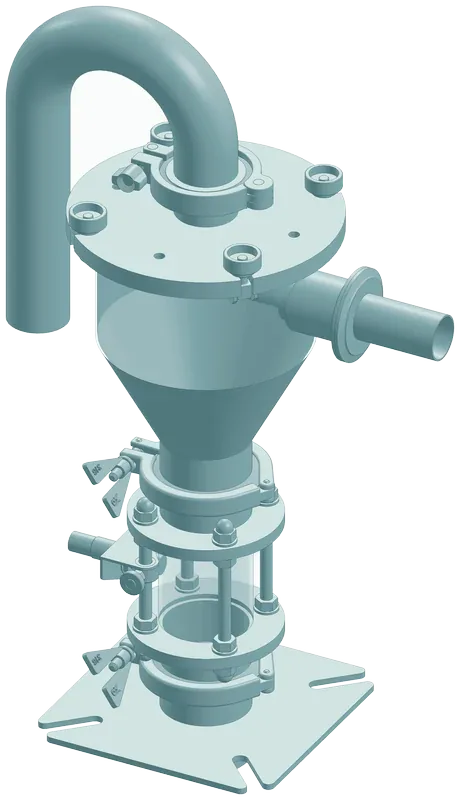
The first loader we designed
The AVL is where the Load-Well™ range started. Everything we have learned about moving material since — how a receiver should come apart, where a sensor belongs, what an operator should never have to adjust — was learned on this machine first.
We still build it, because for a certain kind of duty nothing else is as simple.
It conveys in one run, not in batches
A conventional loader works to a timer. The sensor calls for material, a delay runs, the blower starts and conveys for a preset time — fifteen or twenty seconds — and in that window the receiver fills to its own volume. The blower stops, the flap drops, the charge falls through by gravity, and after another delay the whole thing repeats. Filling a hopper takes many of those cycles, and the conveying time is a number somebody chose.
The AVL conveys in one continuous run for as long as compressed air is available. Material flows until the sensor sees it, and a short top-up time then runs on so the receiver is left full rather than merely satisfied. There is no flap, no gravity dump and no charge to meter.
That removes three things at once: the flap that can stick, the repeated free fall that breaks granules, and the conveying dose that has to be re-timed every time the material, the distance or the lift changes. The AVL's timer tops the receiver up. It does not decide how much material you get — the sensor does.
Level sensed through the glass
A capacitive sensor reads the material through the sight glass. Nothing sits inside the flow path, so there is nothing for material to lodge behind and nothing to clean around — and the operator can see the level the sensor is reading.
What the program does
The loader runs on level first and time second. Four states, and no operator input in any of them:
Receiver full. The sensor reads material, the air valve stays shut and the machine uses nothing.
Level drops. The valve opens and material conveys. It keeps conveying past the moment the sensor is covered, for the set top-up time, so the receiver ends the run full.
Full again. The valve closes.
Nothing arrives. If the sensor is still reading empty when that time is up, the valve closes and the buzzer sounds. The bin is empty, the wand has surfaced, or the line is blocked — and somebody is told about it in seconds.
That last state is the one worth having. A loader running to a plain timer will convey air quite happily and starve the machine while it does, and the first anyone knows about it is short mouldings.
Air you can specify — which is why it suits pharma
A blower loader draws its conveying air from the room. Whatever is in the plant atmosphere — dust, moisture, oil mist drifting off a neighbouring machine — travels through the material on its way to the filter. You can filter what comes out. You cannot specify what went in.
A venturi loader conveys on the plant's compressed air, and compressed air is a supply that can be treated: coalescing filtration, drying, activated carbon, a sterile final filter. Its purity can be specified against a standard — ISO 8573-1 — and certified. That is a conversation you can have with an auditor. Room air is not.
This only holds if the air is actually treated. A venturi fed from an untreated shop line is worse than a blower, because compressor oil and water go straight into the product. Ask us about the air train and we will tell you what it needs.
Why compressed air suits small demand and nothing else
A compressor returns roughly one unit of useful pneumatic work for every seven or eight units of electricity it consumes. Moving a kilogram of granule on compressed air therefore costs several times what the same kilogram costs on an electric blower. That is thermodynamics, and no supplier can argue with it.
But a venturi only spends while it is conveying. A machine that fills for a few seconds every few minutes has a very low duty cycle, and a high cost per kilogram multiplied by a small number of kilograms is a small number — while the blower you did not buy costs nothing to wire, nothing to service and nothing to house.
So the crossover is real and it is about hours, not kilograms. Below a certain daily demand this is the cheaper machine to own. Above it, a blower loader wins easily, and we will tell you so rather than let you find out.
Modular, because it has to be cleaned
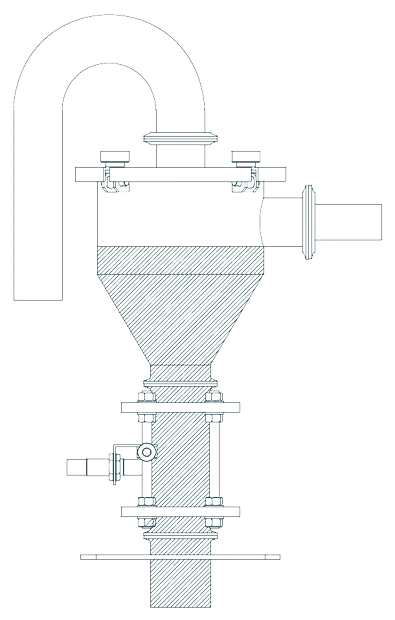
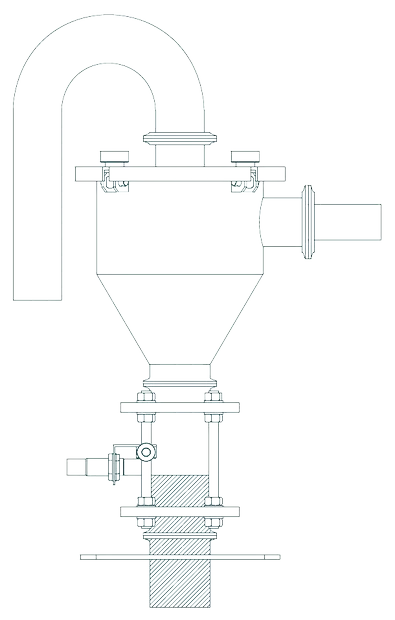
Two tri-clover clamps, and each has a job. The first drops the receiver off the machine. The second releases the sight glass so it comes out on its own.
That means the whole flow path opens by hand, in seconds, with nothing to unbolt — which is what makes a colour change or a material change quick rather than a job somebody postpones. Wetted parts are SS-304 throughout.
Two arrangements, and built to the duty
The exhaust can be taken through a cartridge filter mounted above the receiver, or fitted for a filter bag, depending on the material and the room it runs in.
The receiver is not fixed at 4.4 litres either. Vessel volume, port sizes, the mounting and the height are set out for the machine being fed — the figures below are our standard build, not a limit.
Beyond that, we design to the requirement rather than from a catalogue. Tell us the material, the throughput, the lift and the run, and the machine is set out for that duty.
Specification
| Parameter | Value |
|---|---|
| Type | Compressed-air venturi loader |
| Conveying | Continuous — called by the level sensor, with a top-up time to fill the receiver |
| Control | Level sensor, fill timer and no-material alarm |
| Air control | Solenoid valve |
| Wetted parts | SS-304 |
| Receiver volume | 4.4 L standard; other volumes built to order |
| Level sensing | Capacitive, reading through the sight glass |
| Access | Two tri-clover clamps — receiver and sight glass |
| Exhaust | Cartridge filter above the receiver, or filter-bag arrangement |
| Port | OD 38 mm |
| Mounting plate | 210 × 210 mm |
| Overall height | 625 mm |
| Motor | None |
Conveying capacity depends on material, bulk density, air pressure at the jet, conveying distance and lift. Tell us those and we will quote the rate for your duty. Not recommended for flammable, explosive, liquid or semi-liquid materials.
SVL · SVL SS-304 · PVL
Load-Well™ is a trade mark of A. B. Plastech — application 6999170, Class 7.
Tell us the material and the throughput
Tell us what the material is, how much of it has to move per hour and what machine it feeds, and we will tell you which loader fits — including when the answer is a different model from this one.
A.B. Plastech · Modern Industrial Estate, Bahadurgarh, Haryana
+91 94160 55854 · info@abplastech.co.in