

SpectraCure IR-UV™ infrared and UV-C sterilization
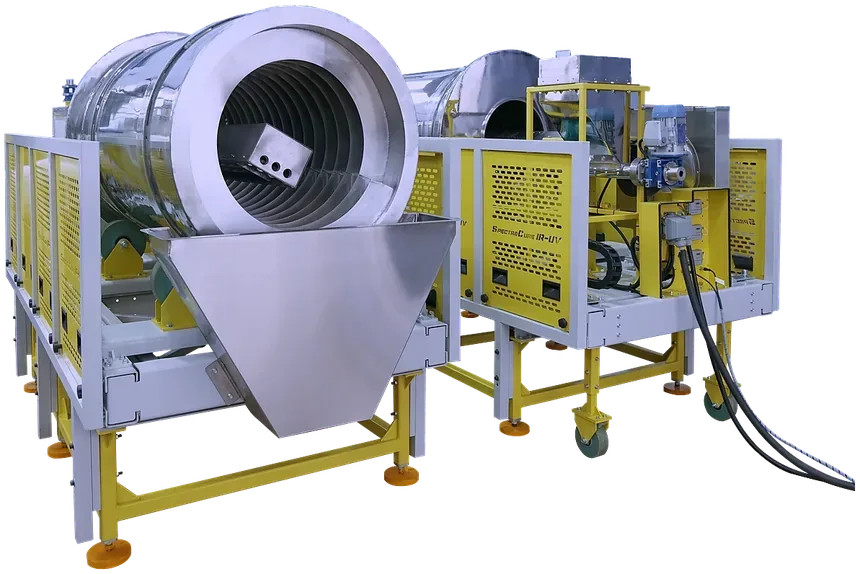
The Roast-O-Dry™ drum with a UV-C stage added alongside the infrared, to reduce the microbial load on nuts, seeds and spices. The two stages run continuously and in synchronisation. No chemicals, no fumigants and no water.
Key features
- Combined shortwave infrared and UV-C sterilization in one machine — continuous and synchronised
- Rotary drum, first‑in first‑out
- PLC control with recipe storage per product
- Interlocked guarding — lamps cut when a door is opened
- Food-grade stainless steel contact surfaces
- Castor mounted with levelling feet — no civil foundation
- No chemicals, no fumigants, no water
- 415 V, 3-phase, 50 Hz
Sizes
| Drum internal diameter | Drum length | Connected load |
|---|---|---|
| 750 mm | 1500 mm | 25 kW |
| 1000 mm | 1500 mm | 30 kW |
| 1200 mm | 1800 mm | 60 kW |
Specifications are varied to suit the application.
Rotary drum vs flat-bed UV-C sterilization
- Product lies still under the lamps
- Only the uppermost face is exposed
- Pieces shade their neighbours and their own undersides
- Every piece is lifted, carried and dropped
- Each face comes round to the UV-C field, again and again
- Continuous, first‑in first‑out
| Flat bed conveyor | Rotary drum | |
|---|---|---|
| Presentation to the lamps | One face, whichever is uppermost | Every face, repeatedly |
| Self-shading | Pieces shade one another in a static bed | Material is re-presented continuously |
| Flow | Continuous | Continuous, first‑in first‑out |
| Floor area | Length set by dwell time | Length wrapped into the drum |
Rotary drum vs flat bed: full explanation
The case for the drum is geometry.
UV-C travels in straight lines and does not turn corners. On a flat bed conveyor the product lies still: the surface facing the lamps is exposed, and whatever is turned away from them, or shaded by the piece beside it, is not. Nuts, seeds and spices are irregular and opaque, so a static bed shades itself. Treating the other side means a second pass, a turning device, or a longer machine.
A drum turns the material continuously. Every particle is lifted, carried and dropped, so each surface comes round to face the field.
This describes exposure, which is mechanical and can be observed. What that exposure achieves in your product is a separate question, dealt with under Process validation below.
Lamp monitoring and safety
Condition monitored
Lamp condition is monitored continuously. A failed or broken lamp stops the feed, the drum, the heating and the lamps together, so no further material passes through the machine.
Breakage contained
A UV-C lamp is a glass envelope. If one breaks, the machine stops before further material passes it, so anything that has entered the product is confined to the charge in the drum at that moment and does not carry into what follows.
Life monitored
Lamp life is monitored, and an alarm is raised at the rated replacement interval.
Life monitoring matters most. A broken lamp is obvious; one still running but down to three-quarters of its rated output is not, and a processor cannot see that failure.
Process validation
We do not publish log-reduction figures, shelf-life claims or microbial data for this machine.
Published figures for UV-C almost all come from juice, liquids or flat surfaces — optically simple targets. Nuts, seeds and spices are none of those. They are dry, opaque and irregular, and the result depends on the product, the load depth, the moisture and the starting condition. A figure measured on another material tells you nothing about yours.
Process validation belongs to the food business operator, under its HACCP plan. Our part is to supply the machine, its parameters and its records so that validation can be carried out against something solid.
Tested with your product before dispatch
We do not keep a demonstration machine. Every machine is built against an order. When yours is complete and before it leaves our works, we run your material through it, to your parameters, and you take the product away for your own laboratory testing. What you validate is the machine you are buying, in its own size and configuration.
Questions buyers ask
What is SpectraCure IR-UV?
The Roast-O-Dry drum with a UV-C stage added alongside the infrared, to reduce the microbial load on nuts, seeds and spices. The two stages run continuously and in synchronisation.
Why a rotary drum for UV-C?
UV-C travels in straight lines and does not turn corners. A flat bed exposes only the uppermost face and pieces shade one another. In a drum every piece is lifted, carried and dropped, so each face comes round to the UV-C field again and again.
Do you publish log-reduction or shelf-life figures?
No. We do not publish log-reduction figures, shelf-life claims or microbial data for this machine. The result depends on the product, the load depth, the moisture and the starting condition.
Who validates the process?
Process validation belongs to the food business operator, under its HACCP plan. Our part is to supply the machine, its parameters and its records.
What happens if a lamp fails?
A failed or broken lamp stops the feed, the drum, the heating and the lamps together, so no further material passes through. Lamp condition and life are monitored.
Does it use chemicals or water?
No. There are no chemicals, no fumigants and no water.
What sizes does it come in?
The same drum sizes as Roast-O-Dry: 750 × 1500 mm, 25 kW; 1000 × 1500 mm, 30 kW; 1200 × 1800 mm, 60 kW. It runs on 415 V, 3-phase, 50 Hz.
How do I get a quote?
Call or WhatsApp +91 94160 55854, or send the quote request on the Contact page. Tell us the material, how much per hour and when you need it. We read every complete enquiry ourselves.
Request a quote for SpectraCure IR-UV™
Tell us the product, its starting condition and moisture, and the throughput you need. We will size the drum and both stages to it.
A.B. Plastech · Modern Industrial Estate, Bahadurgarh, Haryana
pawar@abplastech.co.in
abautomech@hotmail.com