 ™ SVL SS-304
Stainless vacuum loader
for food and pharma
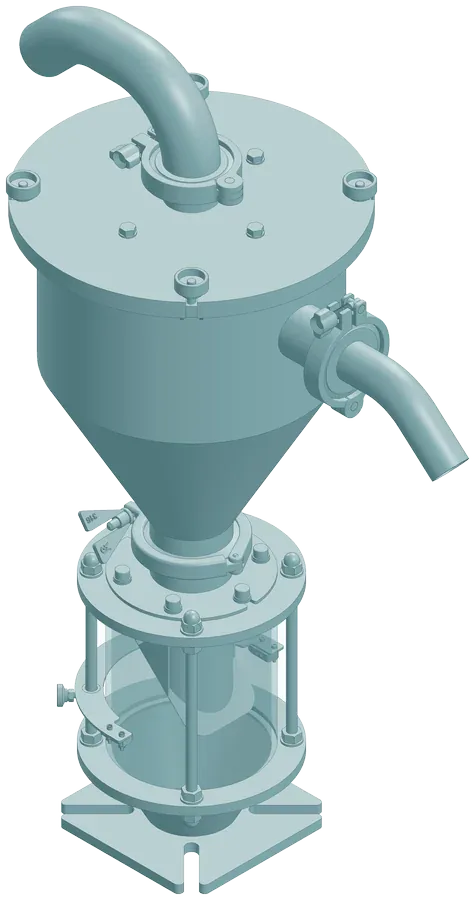
SS-304 throughout, 12 litres effective, OD 50 mm ports, regenerative blower on a 1.5 kW motor. The level sensor sits outside the sight tube, so nothing at all stands in the product path.
Where stainless stops being optional
Coating chips. Mild steel corrodes wherever moisture is allowed to sit. Neither can be shown to an auditor. A machine built for food or pharmaceutical duty therefore has to be stainless from the start, not stainless where it shows.
This loader is SS-304 throughout, clamps included. Where a drawing shows 316 on a clamp, it is because 304 clamps were not to be had when that machine was built and the higher grade went on instead. Either way, nothing in the flow path is below 304.
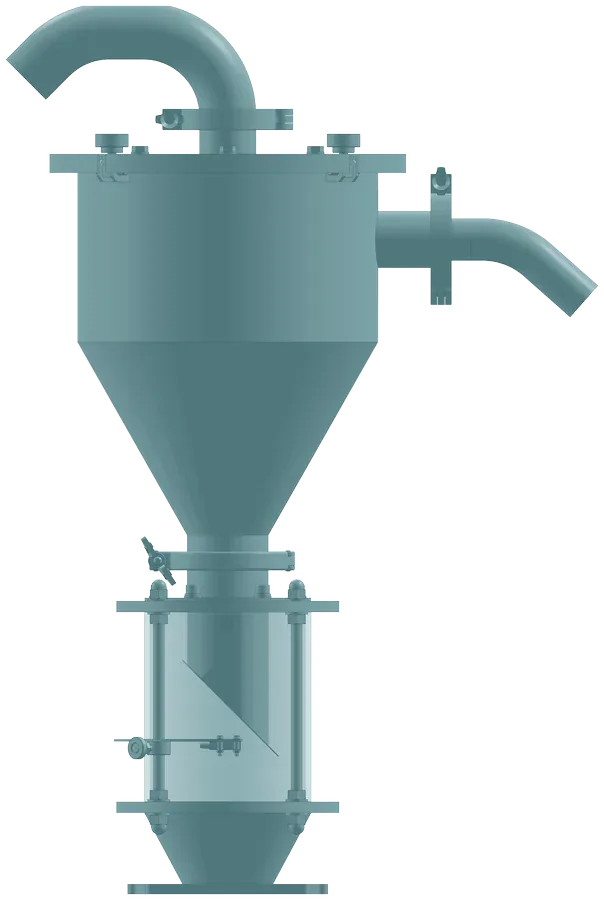
The parts that touch the product are the receiver, cone and lid, the discharge, the wire mesh, the clamps, the polycarbonate sight tube and the gaskets. The gaskets are food grade. Every one of those is listed in the specification below, because "stainless" on its own is not an answer to anybody who has to sign for it.
The level sensor sits outside the machine
Level is sensed by a cross-beam photo-sensor. Both halves of it are mounted on a half-round bracket on the outside of the sight tube, and the beam crosses the tube through its wall.
So there is nothing inside the product path at all. Nothing for product to lodge behind, nothing to dismantle in order to clean, nothing to recalibrate afterwards. In a food or pharmaceutical vessel that is worth more than it sounds — every mechanism inside a vessel is one more surface somebody has to account for.
No cam, and no service call for it
A conventional loader senses level with a cam-operated micro switch. The cam drifts, the switch stops tripping where it should, and somebody has to come and set it again. Every reset is a service call, and across a machine's life those calls cost more than the switch ever did.
There is no cam here. The beam either reaches the far side of the tube or it does not, and a beam has nothing to drift out of. Nothing is set at commissioning and nothing needs resetting afterwards — maintenance on level sensing is as near to nil as we know how to build.
You can watch it discharge
The sight tube is not decoration. The operator sees material actually leaving the receiver, which means a starved line or an empty hopper announces itself, instead of being worked out after the machine has already run dry.
It is polycarbonate rather than glass, and that is deliberate. Polycarbonate is effectively unbreakable and takes the temperatures involved without complaint — and it keeps glass out of a plant where glass is usually controlled or banned outright. Soap and water is all it needs to stay clear.
Two stages of filtration, in two places
Stage one is a fabricated wire mesh in the receiver, keeping product out of the air line. It lifts out for washing.
Stage two is a pleated paper cartridge at the blower, 195 mm outside diameter and 135 mm high, protecting the blower itself.
Two stages in two places, rather than one filter asked to do both jobs: the mesh sits where the product is, the cartridge sits where the machinery is.
Fifty millimetres at both ports
Both the material inlet and the suction port are OD 50 mm, and the regenerative blower runs on a 1.5 kW motor. Conveying capacity is 300–400 kg/hr.
The port size and the motor are specified for the duty rather than for the figure — the material, the length of the hose run, the lift, and the hours the machine will be asked to work. Tell us those four things and we will tell you honestly whether this is the machine for the job.
Ordered to food-grade specification
Where a conforming build is required, the gaskets, the surface finish, the hoses and the clamps are all supplied to food-grade specification, with certificates to match.
Tell us what your auditor asks for and it will be on the machine, documented rather than asserted.
Where it sits
Both ports can be set anywhere through 360°, so the hoses run where the plant allows rather than where the loader dictates. Four metre hoses and a 750 mm lance are supplied with the machine. The receiver mounts on the machine hopper or directly on the machine and feeds just in time, with no intermediate vessel holding product while it waits.
The receiver sits on the machine. The blower and the controller sit away from it, where they can be reached without climbing and heard without shouting.
What it is not for
Not recommended for flammable or explosive materials, nor for liquids or semi-liquids.
Specification
| Parameter | Value |
|---|---|
| Model | Load-Well™ SVL SS-304 |
| Type | Separate receiver and controller |
| Suitable for | Food, pharmaceutical and plastics |
| Wetted parts | Receiver, cone, lid, discharge, wire mesh and clamps — SS-304 |
| Wetted parts, sight tube | Polycarbonate |
| Wetted parts, gaskets | Food grade |
| Receiver capacity | 12 L effective |
| Material inlet port | OD 50 mm |
| Suction port | OD 50 mm |
| Hoses supplied | 4 m, both lines |
| Material input lance | 750 mm long |
| Port orientation | 360° |
| Conveying capacity | 300–400 kg/hr * |
| Blower | Regenerative |
| Motor | Induction, 1.5 kW |
| Power supply | 3-phase, 400 V, 50 Hz |
| Level sensing | Cross-beam photo-sensor, mounted outside the sight tube |
| Filtration, stage 1 | Fabricated wire mesh in the receiver, removable for washing |
| Filtration, stage 2 | Pleated paper cartridge at the blower, OD 195 mm × 135 mm high |
| Mounting | On the machine hopper, or direct to the machine |
| Food-grade specification | Available to order — gaskets, surface finish, hoses and clamps supplied conforming, with certificates |
* Conveying capacity depends on material type, conveying distance and vertical lift. Not recommended for flammable, explosive, liquid or semi-liquid materials. All specifications are subject to change without notice to improve reliability, function or design.
Load-Well™ is a trade mark of A. B. Plastech — application 6999170, Class 7.
Tell us the material and the throughput
Tell us what the material is, how much of it has to move per hour and what machine it feeds, and we will tell you which loader fits — including when the answer is a different model from this one.
A.B. Plastech · Modern Industrial Estate, Bahadurgarh, Haryana
+91 94160 55854 · info@abplastech.co.in