 ™
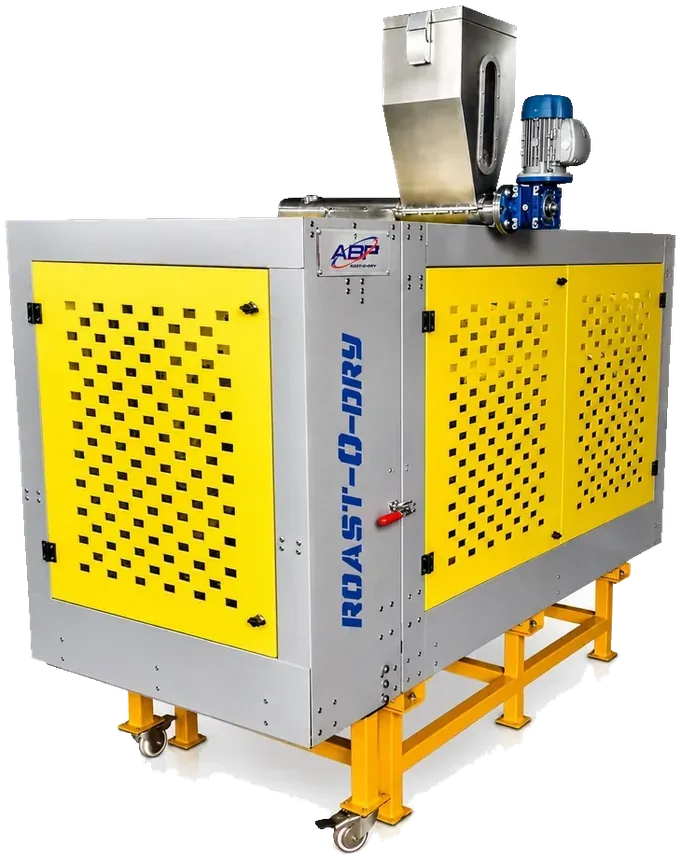
™ Infrared rotary
roaster and dryer
Continuous rotary processing for nuts, seeds, spices and grain. Shortwave infrared heating, first-in first-out flow, no chemicals and no water.
Why infrared rather than hot air
A conventional roaster or dryer works by convection. A burner or heater raises the temperature of a large volume of air, a fan moves that air through the product, and the air gives up its heat on the way past. The air is the carrier, and the carrier has to be heated first.
Infrared is radiant. Energy travels from the emitter to the material directly. There is no medium in between, and four things follow.
Energy goes into the product rather than into a volume of air that is then blown through it.
Convective systems lose heat through ducting, leakage and exhaust, because the air must be moved and moved air escapes.
Emitters reach working output immediately. There is no warm-up period while a mass of air comes up to temperature.
Switch off and the heat stops. A convective system holds its heat in the air and the ductwork, so the plant must cool before the next product goes through.
For a processor running several products in a shift, the last of those is often worth more than the energy saving.
Shortwave, not medium or long
The emitters are shortwave. Shortwave infrared penetrates further into the material than medium or long wave, so the heat is developed within the piece rather than only at its surface. That is what allows the drum to run without scorching the outside to dry the inside.
Why a rotary drum
A flat bed or belt carries the product in a static layer. The surface facing the heaters takes the energy; the layer underneath takes what reaches it. Even at low bed depths the top scorches before the bottom is done, which is why belt roasters run long and slow.
A drum turns the material continuously. Every particle is lifted, carried and dropped, so each one is presented to the radiant field over and over rather than sitting in one position for the whole pass.
- Continuous first-in first-out flow — no batch sits longer than another, and nothing carries over
- The whole charge is presented to the field, not only the top layer
- The heated length is wrapped into a drum, so the machine occupies a fraction of the floor a belt of equivalent dwell time would need
Construction
- Rotary drum, continuous first-in first-out flow
- Shortwave infrared heating
- PLC control with recipe storage per product
- Food-grade stainless steel contact surfaces
- Castor mounted with levelling feet — no civil foundation
- Full access for cleaning and product changeover
- No chemicals, no fumigants, no water
- 415 V, three phase, 50 Hz
Sizes
| Drum internal diameter | Drum length | Connected load |
|---|---|---|
| 750 mm | 1500 mm | 25 kW |
| 1000 mm | 1500 mm | 30 kW |
| 1200 mm | 1800 mm | 60 kW |
Capacity is not a function of drum volume. It is governed by the internal geometry, which is specified for the material — a larger drum carries a deeper charge and needs proportionally more heat, which is why the load does not scale with size.
Specifications are varied to suit the application.
Throughput
Throughput is quoted against your material, not as a single figure. It depends on bulk density, initial moisture and the dwell time the product needs — and those three vary more between products than the machine does.
Tell us the material, the moisture you start at and the moisture you need, and we will size the machine to it.
Nothing passes a failed heater
Heater condition is monitored continuously. A failed heater stops the feed, the drum and the heating together, so no material passes through an under-heated machine.
An infrared emitter is a quartz envelope. If one breaks, the machine stops before further material passes it, so anything that has entered the product is confined to the charge in the drum at that moment and does not carry into what follows.
Heater life is monitored, and an alarm is raised at the rated replacement interval.
The last of those matters more than it appears. A heater that has failed is obvious. One still drawing power but down to three-quarters of its rated output is not — and the product that comes out is under-processed in a way nobody sees until it is packed.
Trials are run on your own machine
We do not keep a demonstration machine. Every machine is built against an order. When yours is complete and before it leaves our works, we run your material through it, to your parameters, and you take the product away for your own testing. What you assess is the machine you are buying — not a demonstration unit that differs from it.
A.B. Plastech · Modern Industrial Estate, Bahadurgarh, Haryana
+91 94160 55854 · info@abplastech.co.in